
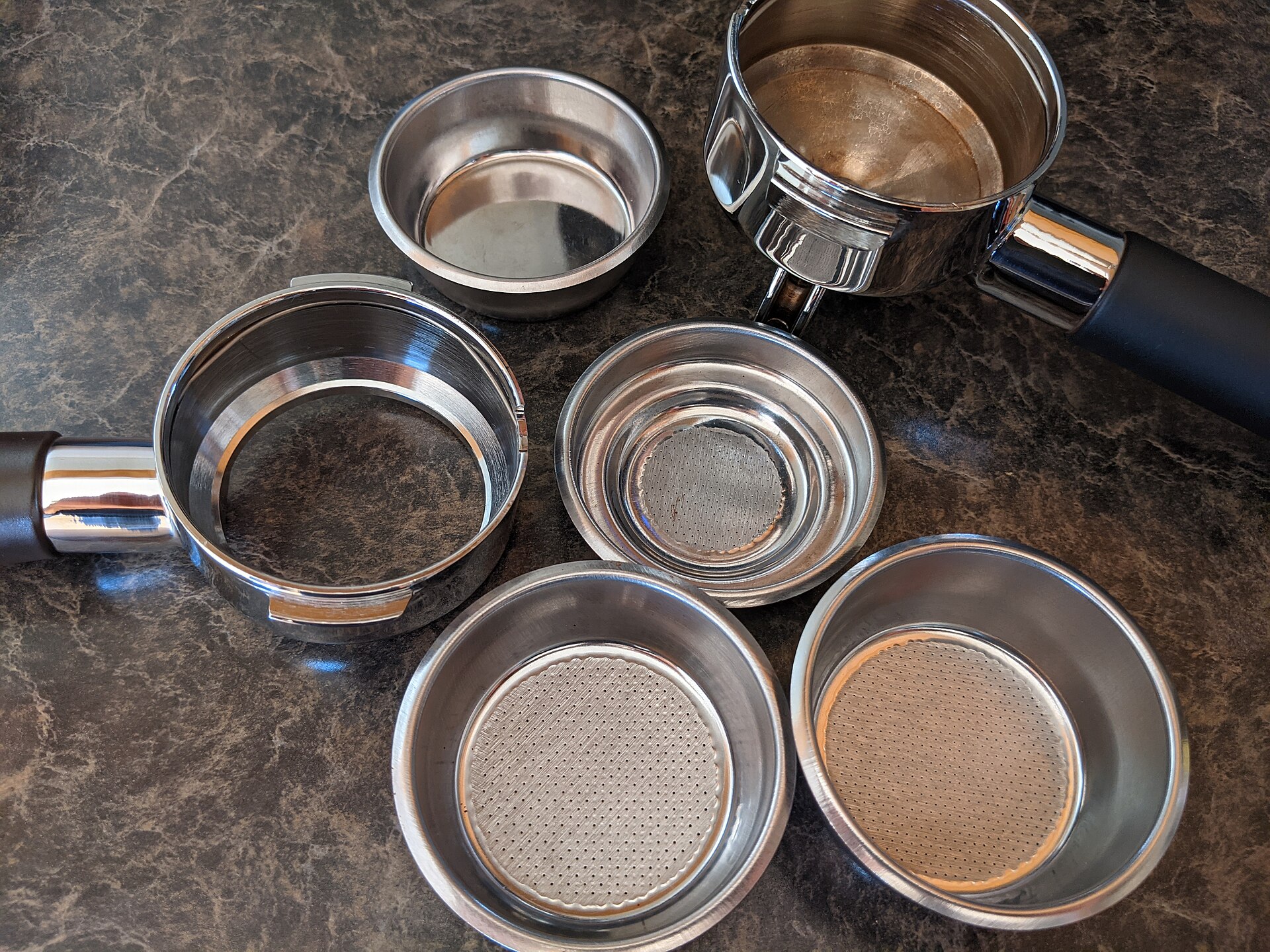
Quick fix: Flip your basket over. One tiny hole underneath means it’s pressurized: grind tweaks barely register, so adjust dose, freshness and shot volume instead. Holes across the whole floor mean it’s non-pressurized: grind fresh for espresso, prep the puck with care and make grind size your main dial. Pre-ground coffee? Stay pressurized.
Reviewed 24 Oct 2026 by the PCA Editorial Team · All espresso fixes
How each basket works
Espresso needs resistance. The pump pushes water at the coffee, and something has to hold that water back long enough to build pressure and extract flavour. The two basket types put that resistance in different places.
- Pressurized (dual-wall, double-wall): an inner basket with many holes sits on an outer wall with one small hole, or sometimes a few. Breville explains that forcing water through that small hole creates back pressure, which “compensates for inconsistencies” such as uneven tamping or the wrong grind size (Breville).
- Non-pressurized (single-wall): one floor perforated all over. Here, Seattle Coffee Gear notes, “nearly all of the resistance is created by the coffee, not by the basket” (Seattle Coffee Gear). This is how café espresso is made.
Neither type is a trick. They suit different setups. Seattle Coffee Gear puts it simply: if you use pre-ground coffee, a pressurized basket gives you the best results; if you have a quality burr grinder and fresh beans, start with a non-pressurized double basket (Seattle Coffee Gear Learning Center).
Which one do you have?
Take the basket out of the portafilter and turn it over.
- One tiny hole (or a few) underneath, with a perforated floor inside: pressurized.
- Holes across the whole underside, the same as the inside: non-pressurized.
- A removable perforated disc on top of a solid-looking cup: also pressurized. The disc is the inner wall.
Breville / Sage Bambino (54 mm)
The Bambino (BES450, sold as SES450 under the Sage name) uses a 54 mm portafilter and, in many markets, comes with both Single Wall and Dual Wall filter baskets in 1-cup and 2-cup sizes. Breville’s manual says to use Single Wall baskets when you grind fresh whole beans, and Dual Wall baskets for pre-ground coffee and for older beans past the 30-day roast date, because the dual-wall baskets “regulate the pressure” regardless of grind, dose, tamp or freshness (Breville Bambino instruction book). Check your box, though: Breville’s Canadian product page lists only the dual-wall baskets as included accessories (Breville Canada).
De’Longhi Dedica (51 mm)
De’Longhi lists “double wall filters + aluminium portafilter” for the Dedica Style (EC685), and the same for the Dedica Arte and Stilosa (De’Longhi). The machine comes with a 1-cup filter, a 2-cup filter and an E.S.E. pod filter. The manual tells you to pull out the perforated filter by its tab for cleaning and to keep the hole on the back of the filter clear. That removable inner disc and single rear hole are the dual-wall design (De’Longhi EC685 manual). De’Longhi’s own tamper is 51 mm and is “specifically designed to fit all De’Longhi portafilters” (De’Longhi DLSC080).
Budget machines
Here’s the plot twist with cheap machines: the basket matters more than the badge. Seattle Coffee Gear notes that most entry-level home machines ship with pressurized baskets, and that the most common portafilter sizes are 58 mm (most prosumer machines), 54 mm (Breville’s mid-range) and 51 mm (De’Longhi and other entry-level machines) (Seattle Coffee Gear Learning Center). So a compact pump machine from a big appliance brand will very likely hand you a dual-wall basket. Very likely isn’t certain, though.
The number printed on the box (15, 19, 20 bar) tells you nothing about the basket. Before you buy a tamper or a new basket, spend two minutes on this:
- Do the flip test above.
- Measure the inside diameter of the basket with a ruler.
- Check the manual’s accessories list for “dual wall”, “double wall” or “pressurized”.
Baskets must match your portafilter’s diameter, and most are not universal. If you upgrade later, a non-pressurized basket usually costs under $30, according to Seattle Coffee Gear, but it only pays off with a burr grinder and fresh beans. With pre-ground coffee, the pressurized basket you already own is the right tool.
Side by side
| Pressurized (dual-wall) | Non-pressurized (single-wall) | |
|---|---|---|
| Resistance comes from | The basket’s exit hole | The coffee puck |
| Coffee | Pre-ground espresso coffee, older beans, E.S.E. pods (with a pod filter) | Fresh beans ground for espresso just before brewing |
| Grinder needed | None | A burr grinder that can grind fine for espresso |
| Main controls | Dose, freshness, shot volume | Grind size, then dose and ratio |
| Puck prep | Matters less | Essential |
| Flavour ceiling | Limited; less full-bodied | Higher, with practice |
How to dial in a pressurized basket
With a dual-wall basket, small grind changes do much less, because the basket is doing the job the grind would normally do. Spend your effort on the controls that still work.
- Use coffee ground for espresso. De’Longhi’s manual says to use finely ground coffee specifically for espresso, and lists coffee that is too coarse or too fine among the causes of a bad shot (De’Longhi). Very fine “Turkish” powder can choke the basket.
- Keep pre-ground coffee fresh. Breville advises using pre-ground coffee within a week of grinding (Breville). Buy small packs and keep them sealed.
- Fill the basket to its design dose. The Bambino baskets are designed for 8–11 g (1 cup) and 16–19 g (2 cup). On the Dedica, use the supplied measure and the right filter: the manual lists too much coffee as the reason a filter holder won’t lock in.
- Tamp level and consistently. De’Longhi notes that pressing too firmly makes coffee run slowly and taste strong, and pressing too lightly makes it run fast and weak. Pick one firmness and repeat it.
- Set the shot volume, then taste. The Bambino’s presets are about 30 ml (1 cup) and 60 ml (2 cup); the Dedica defaults to 35 ml and 70 ml, and both can be reprogrammed. If the shot tastes thin and harsh at the end, try a shorter shot. If it tastes sour and sharp, try a slightly higher dose or fresher coffee before anything else.
- Keep the filter clean. A partly blocked exit hole changes the flow. Both manuals tell you to rinse the baskets after use and clear blocked holes with a pin or the cleaning tool.
Don’t judge a pressurized shot by its crema. The basket builds pressure on its own, so a thick foam on top tells you less about your grind than it would in a single-wall basket. Trust your taste.
How to dial in a non-pressurized basket
Here the puck does all the work, so grind size becomes your main control and puck prep matters.
- Start with fresh beans and a burr grinder. Breville recommends beans with a “Roasted On” date and suggests using them between 5 and 20 days after roasting (Breville). Pre-ground coffee is usually too coarse and too stale for a single-wall basket.
- Weigh your dose. Use the basket’s range (16–19 g for the Bambino 2-cup basket) and keep it fixed while you adjust grind.
- Fix a ratio. Weigh what comes out. A 1:2 ratio (about twice the dry dose in liquid espresso) is a practical starting point.
- Distribute, tamp level, pull. Break up clumps, level the bed and tamp once. Uneven pucks cause channeling, where water finds an easy path through the coffee.
- Read the flow. Breville’s guide for the Bambino: espresso should start to flow after about 8–12 seconds and pour like warm honey. If it starts in under about 7 seconds, grind finer or check your dose. If it only drips after 12 seconds, grind coarser.
- Taste, then change one thing. Sour, sharp and thin usually means under-extracted: grind finer. Bitter, harsh and drying usually means over-extracted: grind coarser.
If you have a Dedica or a budget machine and want to try this, 51 mm single-wall baskets are sold separately. Before you buy one, make sure your grinder can grind fine enough for espresso. Without that, a single-wall basket will mostly give you fast, sour shots.
Should you switch?
- Stay with pressurized if you buy pre-ground coffee, don’t own a burr grinder, or want a reliable cup on busy mornings.
- Move to non-pressurized once you have fresh beans and a grinder that can grind fine for espresso. Breville calls this a natural step as your skill grows, and notes many portafilters accept both types, so you can keep one of each (Breville).
Ready to dial in by taste? Our short video course Dial In Espresso by Taste walks through basket types, the 1:2 ratio and how to tell sour from bitter shots, with short video lessons and quizzes.
Frequently asked questions
Can I use freshly ground beans in a pressurized basket?
Yes. It will work, but grind changes will have less effect because the basket controls the pressure. You get more from fresh beans in a single-wall basket.
Why does grinding finer not change my shot?
You are probably using a pressurized basket. Its exit hole sets most of the resistance, so adjust dose, freshness and shot volume instead, or switch to a single-wall basket.
Do 58 mm baskets or tampers fit the Bambino or Dedica?
No. The Bambino uses 54 mm and the Dedica uses 51 mm. Buy parts made for your machine’s size.
Keep learning
- Espresso Dial-In Guide
- Espresso Extraction Workflow
- Coffee Extraction Science
- Barista-Style Coffee at Home
Sources
- Breville. the Bambino BES450 Instruction Book (ANZ, 2021).
- Breville. the Bambino BES450 product page (Canada).
- Breville. Pressurized vs. non-pressurized baskets.
- De’Longhi. EC685 / EC695 / EC785 instructions for use (hosted by Conrad).
- De’Longhi. Pump Driven Coffee Machines (Dedica range).
- De’Longhi. Black Wood Espresso Tamper DLSC080 (51 mm).
- Seattle Coffee Gear. Choosing the Right Portafilter Basket.
- Seattle Coffee Gear (2019). Pressurized Vs. Unpressurized: What’s the Difference?
Checked 22 October 2026.
Featured image: “Portafilters and filter baskets used for espresso brewing” by massage-techniques, via Wikimedia Commons, CC BY-SA 2.0.
Leave a Reply